
Catalinbread | Dreamcoat | Preamp | Based on the Blackmores Aiwa TP-1011
What began as an exploration of Ritchie Blackmore’s tone evolved into a multidimensional gain machine capable of anything between unruly sputtery fuzz and classic rock chime. This is not meant to make you sound like Blackmore, it is meant to inspire you from using the tools that he did, that would otherwise be inaccessible in pedal form.
The heart and soul of the Dreamcoat is a near-exact recreation of the preamp circuit from the Aiwa TP-1011 reel-to-reel deck that Blackmore used on many of his recordings. All of the functionality of that unit is present, from sparkling cleans to powerful crunch and glassy leads, but the “Sat” control gives you an extra layer of grunt, allowing the Dreamcoat to range between near-dry tonal indifference to complete “melting-amp” Neil Young-esque tweed sounds. Blackmore’s sound wasn’t just a tape deck, though. His guitar tech, Dawk Stillwell, installed a passive inductor-based frequency “booster” into Ritchie’s Strat that cut both sides of the spectrum around the resonant frequency of his guitar, giving the appearance of frequency boost. To that end, we’ve added a frequency booster circuit that doesn’t cut anything, giving you a richer tone with a little oomph where it counts.
To top it all off, we’ve included a clean blend circuit that begins after the frequency boost and ends after the tape preamp, so you can EQ the sum of your clean tone and dirt, all while preserving your pick attack and presence. The whole shebang runs at 20V, just a hair higher than the original Aiwa, expanding its capabilities and delivering tons of headroom.
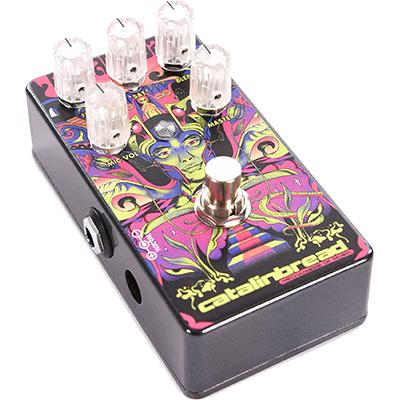
FREQ: This controls the amount of boost at a specified frequency band, from 2.4KHz to 5KHz, which you set with the internal trimmer. When the knob is fully counter-clockwise, it’s out of the circuit. When you turn it up all the way, you’ll get a full 10dB boost at the selected frequency. Warning: a little goes a long way with this control, as ~4KHz is where pink noise and other unpleasantries live.
BLEND: This control blends the signal coming out of the Freq control with the Aiwa deck circuit. Nudge it south-of-max to gain back some of your pick attack, and turn it all the way down to hear just the EQ’d dry signal. When all the way down, make sure you turn your master up to compensate and
vice-versa. When your Sat and Mic Vol are cranked and your Blend is just above 0, the resulting dynamic between your dry signal and those more extreme splatty Dreamcoat settings create a truly unique tone.
SAT: Controls the amount of feedback present in the first stage of the Aiwa unit. You can think of it as a “gain range” control. This control was not included on the original unit and was set to a fixed value. The default setting on the original is a hair past noon, everything else is extra. If you find that you are getting too much sputter, turn this control down.
MIC VOL: This is the original “distortion” control of the Aiwa deck and controls the total “distortion” of the circuit.
MASTER: You know what this does. You will never want for volume with the Dreamcoat, it can get punishingly loud. After all, the Aiwa was meant to drive speakers! As you adjust the Blend control, you may need to turn this up.
FREQUENCY TRIMMER: Blackmore had his passive “boost” tailored to the resonant frequency of his Strat, accentuating pinch harmonics. While you may not play the man’s actual guitar (seriously, props if you do), you may want to spend some time dialing this in. This is definitely a “set-it/forget-it” type of control, as you dial it to suit your guitar best. Of course, you can experiment with different frequencies and let the FREQ knob do the talking.
The Dreamcoat requires a 9V power supply center-negative and draws 44mA. Any more current than that is A-OK, but you can’t exceed 9V without letting the smoke out. Bad things will happen, including but not limited to shouting expletives and more importantly, voiding your warranty.
Current draw: 44mA
Input impedance: >1MΩ
Output impedance: <5KΩ
Dimensions: 4.33” X 2.36” X 1.93”
Weight: 0.4 lbs
Original: $148.85
-65%$148.85
$52.10Product Information
Product Information
Shipping & Returns
Shipping & Returns
Description
What began as an exploration of Ritchie Blackmore’s tone evolved into a multidimensional gain machine capable of anything between unruly sputtery fuzz and classic rock chime. This is not meant to make you sound like Blackmore, it is meant to inspire you from using the tools that he did, that would otherwise be inaccessible in pedal form.
The heart and soul of the Dreamcoat is a near-exact recreation of the preamp circuit from the Aiwa TP-1011 reel-to-reel deck that Blackmore used on many of his recordings. All of the functionality of that unit is present, from sparkling cleans to powerful crunch and glassy leads, but the “Sat” control gives you an extra layer of grunt, allowing the Dreamcoat to range between near-dry tonal indifference to complete “melting-amp” Neil Young-esque tweed sounds. Blackmore’s sound wasn’t just a tape deck, though. His guitar tech, Dawk Stillwell, installed a passive inductor-based frequency “booster” into Ritchie’s Strat that cut both sides of the spectrum around the resonant frequency of his guitar, giving the appearance of frequency boost. To that end, we’ve added a frequency booster circuit that doesn’t cut anything, giving you a richer tone with a little oomph where it counts.
To top it all off, we’ve included a clean blend circuit that begins after the frequency boost and ends after the tape preamp, so you can EQ the sum of your clean tone and dirt, all while preserving your pick attack and presence. The whole shebang runs at 20V, just a hair higher than the original Aiwa, expanding its capabilities and delivering tons of headroom.
FREQ: This controls the amount of boost at a specified frequency band, from 2.4KHz to 5KHz, which you set with the internal trimmer. When the knob is fully counter-clockwise, it’s out of the circuit. When you turn it up all the way, you’ll get a full 10dB boost at the selected frequency. Warning: a little goes a long way with this control, as ~4KHz is where pink noise and other unpleasantries live.
BLEND: This control blends the signal coming out of the Freq control with the Aiwa deck circuit. Nudge it south-of-max to gain back some of your pick attack, and turn it all the way down to hear just the EQ’d dry signal. When all the way down, make sure you turn your master up to compensate and
vice-versa. When your Sat and Mic Vol are cranked and your Blend is just above 0, the resulting dynamic between your dry signal and those more extreme splatty Dreamcoat settings create a truly unique tone.
SAT: Controls the amount of feedback present in the first stage of the Aiwa unit. You can think of it as a “gain range” control. This control was not included on the original unit and was set to a fixed value. The default setting on the original is a hair past noon, everything else is extra. If you find that you are getting too much sputter, turn this control down.
MIC VOL: This is the original “distortion” control of the Aiwa deck and controls the total “distortion” of the circuit.
MASTER: You know what this does. You will never want for volume with the Dreamcoat, it can get punishingly loud. After all, the Aiwa was meant to drive speakers! As you adjust the Blend control, you may need to turn this up.
FREQUENCY TRIMMER: Blackmore had his passive “boost” tailored to the resonant frequency of his Strat, accentuating pinch harmonics. While you may not play the man’s actual guitar (seriously, props if you do), you may want to spend some time dialing this in. This is definitely a “set-it/forget-it” type of control, as you dial it to suit your guitar best. Of course, you can experiment with different frequencies and let the FREQ knob do the talking.
The Dreamcoat requires a 9V power supply center-negative and draws 44mA. Any more current than that is A-OK, but you can’t exceed 9V without letting the smoke out. Bad things will happen, including but not limited to shouting expletives and more importantly, voiding your warranty.
Current draw: 44mA
Input impedance: >1MΩ
Output impedance: <5KΩ
Dimensions: 4.33” X 2.36” X 1.93”
Weight: 0.4 lbs